

MediKids: Sen. Kim’s Vision to Cover All Kids

The American people do not believe that children should be sick, in pain, or without preventive care like vaccinations and annual check-ups based on the wealth of a child’s parents, their zip code, their health care status, or simply because their parents have lost their job or can’t afford the skyrocketing costs of health insurance. The vast majority of Americans believe that all children should have health coverage, just like the guarantee that senior citizens get from Medicare.
Millions of children are losing health coverage. After years of reducing the uninsured rate for children to historic lows, America is moving backward. As Sen. Andy Kim (D-NJ) points out, the number of uninsured children has grown to nearly 4.5 million, and there are another 23 million who are underinsured.
For the sake of our children and grandchildren and their future, we must get back on the right path toward progress rather than regression.
A Landmark Proposal
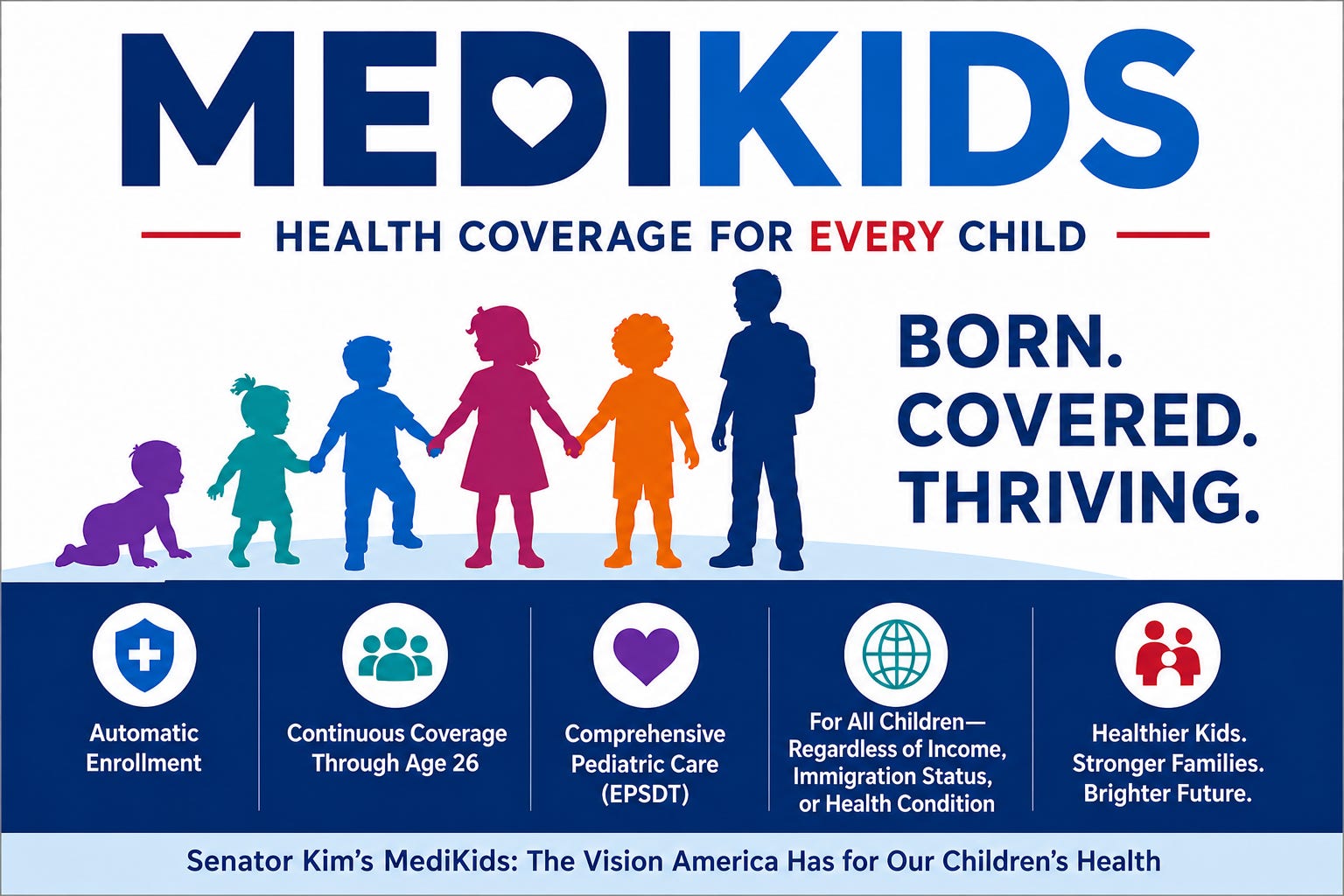
On July 21, Senator Andy Kim (D-NJ) took a major step forward in introducing MediKids (S. 5037), a monumental piece of legislation that would guarantee health care coverage to every child in America from birth to age 26.
The Senate bill, cosponsored by Sens. Cory Booker (NJ), Tammy Duckworth (IL), and Alex Padilla (CA), would automatically enroll every child at birth in Medicaid’s Early and Periodic Screening, Diagnostic, and Treatment (EPSDT) benefit — the program’s comprehensive, pediatric-specific standard of care — and guarantee continuous eligibility to coverage, regardless of income, immigration status, or health condition.
At First Focus Campaign for Children, we were pleased to work with Sen. Kim on the legislation and joined other national, state, and local organizations[1] in support of it. Our statement explains:
At a time when the uninsured rate for children is rising and children face unacceptably high rates of infant and child mortality, a growing mental health crisis, and declining immunization rates, Senator Andy Kim’s MediKids bill puts children back on the path toward ensuring all children have health coverage and improved access to care. No child in this country should go without health care simply because of what their parents earn, their zip code, or whether they can navigate a complex and fragmented health care system. In an effort to improve the health, development, and well-being of children, MediKids represents the kind of ambitious, child-centered thinking that the moment demands for our children and grandchildren.
Sen. Kim’s vision for MediKids (S. 5037) is the right one, which is to ensure that all kids are covered, just as the nation does for senior citizens with the Medicare program.

The American Dream of Covering Every Child
The idea of covering every child goes back to the time when Medicare and Medicaid were first created. In 1965, when Secretary of Health, Education, and Welfare (HEW) Joseph Califano chaired an Interagency Task Force on Health Care that proposed to President Lyndon Johnson a comprehensive set of proposals to enable “every child to have the medical care he needs to develop his capabilities.” While political events at the time allowed Medicare to be created, children’s coverage was limited to just the lowest-income kids through Medicaid.
In a comprehensive review of the history of maternal and child health improvements [2], health policy expert Kay Johnson explains that prior to the creation of Medicaid, about one-in-four children lacked health coverage. The vision of covering all kids never went away, however, and she lays out the subsequent timeline of improvements as follows:
Assistant Secretary (and later HEW Secretary) Wilbur Cohen championed a proposal known as “Kiddycare,” which would have provided universal social insurance coverage for maternity care and infant care during the first year of life for every mother and baby in the country, regardless of income — a true universal approach, not the means-tested program Medicaid became;
President Carter’s 1977 Child Health Assessment Program (CHAP), which would have expanded Medicaid to hundreds of thousands more poor children under age six;
Rep. Henry Waxman’s Child Health Assurance Act in 1979 that proposed extending Medicaid to every child under 18 and every pregnant woman, regardless of state-by-state variation; and,
The Medicaid incremental but critically important expansions signed into law in subsequent budget bills that lowered the uninsured rate to around 15% by 1996.
In 1997, Congress passed, and President Clinton signed into law, the creation of the Children’s Health Insurance Program (CHIP). CHIP became one of the most successful bipartisan health initiatives in American history. In tandem with Medicaid, it reduced the uninsured rate among children by more than two-thirds, from 15% in 1996 to a record low of 4% in 2016.
But as Johnson explains, the story of nearly every gain child advocates have won is not through one triumphant bill, but persistence over years, sometimes decades, of different bills and different approaches, all aimed at the same underlying goal or vision of covering all kids.
This brings us to the name “MediKids” itself. This is not the first time it’s been used. Rep. Pete Stark (D-CA) and Sen. Jay Rockefeller (D-WV) introduced a MediKids Health Insurance Act in several sessions of Congress — each time proposing to guarantee coverage for all children.
Sen. Kim’s bill picks up that torch that has been carried, set down, and picked back up again for over three generations. That has always been the point of legislation like this: establishing the goal of ensuring that every child is covered is on the table, argued for, refined, and ready whenever the moment for it finally arrives.
At a time when we are living through retrenchment and rising levels of uninsured children, Sen. Kim’s proposal to set the country back on the right path of covering all kids is timely and desperately needed.

Why the Moment Is Now
MediKids doesn’t arrive in a vacuum. It arrives as a direct answer to a crisis this Congress and Administration have created with the passage of H.R. 1, the so-called “One Big Beautiful Bill” (OBBB). At the time, despite numerous warnings about the threat the legislation would pose to children, supporters of the act, including Secretary Robert F. Kennedy, Jr., asserted that kids would be protected.
They were wrong.
As I wrote last month, the promise Congress and the administration made — that children were protected and that the Medicaid cuts targeted only able-bodied adults — was false. The Congressional Budget Office (CBO) estimates that OBBB cuts federal Medicaid and CHIP spending by nearly $1.2 trillion through 2036, the largest cut to the program in its 60-year history, and projects that nearly 3 million children will lose Medicaid coverage as a result.
We don’t have to wait for that projection to play out. Georgetown University’s Center for Children and Families (CCF) has already reported that 2 million fewer children were enrolled in Medicaid and CHIP as of this spring than when President Trump took office, even though income eligibility for kids hasn’t changed and unemployment has been rising.
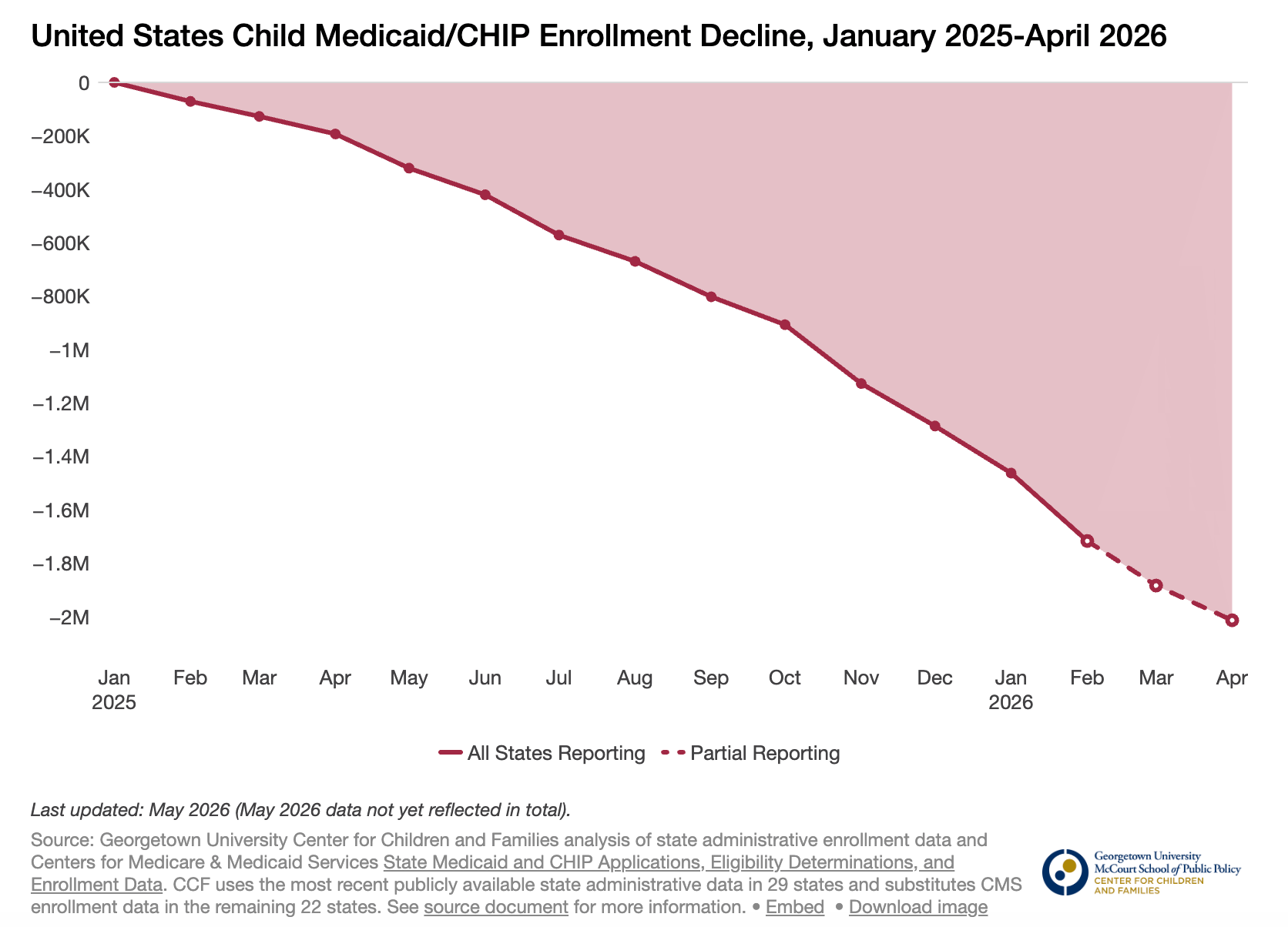
These are not children who became ineligible. They are children caught in what CCF describes as the “unwelcome mat” effect: a parent who can’t document 80 hours of work a month, a state’s system that isn’t automated, a redetermination notice that gets lost in the mail — and the whole family, kids included, falls off the rolls.
To a child, it doesn’t matter whether the coverage loss traces back to a work requirement, a paperwork barrier, or a congressional budget score. They experience only the outcome: a missed check-up, a skipped vaccination, a delayed cancer diagnosis, and failure to meet developmental goals.
MediKids is, in effect, the opposite bet.
OBBB uses technology to create added friction, barriers, and redetermination hurdles to make eligibility harder to maintain. MediKids removes those barriers to care for children and, as Medicare does for seniors when they turn 65, creates a default and expectation of enrollment at birth, guaranteed, continuous coverage, no annual paperwork barriers, no churn, and no families navigating a bureaucracy to keep a child covered.

Children Are Not Little Adults
Any serious approach to covering kids must recognize, although it is routinely ignored in health policy debates, that children are not little adults. Children’s bodies and minds are actively developing, which means their care should lean toward prevention, habilitation, and developmental milestones rather than the maintenance and rehabilitation that defines most adult and senior care.
Healthy child development depends on preventive care, developmental screening, early intervention, immunizations, and continuous monitoring during years of rapid physical and neurological growth. Interrupting that care carries consequences that can last a lifetime. This difference, in fact, explains the creation of the medical field of pediatrics and the establishment of children’s hospitals and other pediatric specialty care.
Dr. Kurt Newman, former president and CEO of Children’s National, put it simply in his book Healing Children:
[Children] need specialty centers with doctors, nurses, psychologists, social workers, orderlies, administrators, and maintenance staff devoted to fostering an environment attuned to their unique psychology, biology, and medical conditions.
This is exactly why Medicaid’s EPSDT benefit exists, and why it’s the right foundation for a bill like MediKids to build on. Unlike a generic insurance benefit designed around adult care patterns, EPSDT was built in recognition of children’s unique need for developmental screening, immunization schedules, and the full range of physical, dental, vision, and behavioral health services. A pediatric-focused benefit isn’t a nice-to-have: it’s the whole point.
Children’s health coverage is also one of the country’s smartest long-term investments. Healthy children are more likely to succeed in school, graduate, participate in the workforce, and avoid costly medical crises later in life. Covering children isn’t simply compassionate policy – it reduces future public costs while strengthening the nation’s future workforce.
There is strong support by the American people for recognizing the unique needs of children. When pollsters have asked voters directly whether they support “ensuring that all children have health coverage,” the answer has come back nearly nine-to-one in favor. When CHIP itself was on the chopping block, voters opposed eliminating or scaling it back by overwhelming three-to-one margins. There is no meaningful constituency in this country that wants to see kids uninsured.
Back in 2019, child advocates – including the American Academy of Pediatrics, Children’s Defense Fund, Children’s Hospital Association, Family Voices, First Focus on Children, Georgetown’s CFF, March of Dimes, and National Association of Pediatric Nurse Practitioners – laid out a set of principles for health reform for children. The core of those principles still holds:
As a nation, we must build on what is working for millions of children, pregnant women and their families by keeping Medicaid and CHIP strong and enrolling all eligible children, strengthening private coverage, and working toward a health care system that meets the needs of ALL children, pregnant women, and their families, regardless of their health or immigration status, family income, or zip code. Any change to our health care system must further improve coverage for children and pregnant women. They must not lose ground.
Put simply: first, do no harm. That principle exists because history has taught child advocates, repeatedly and painfully, that “reform” is not automatically good for kids just because it expands coverage somewhere else in the system. There have been many steps forward, but also steps backward, as we are witnessing at this very moment.
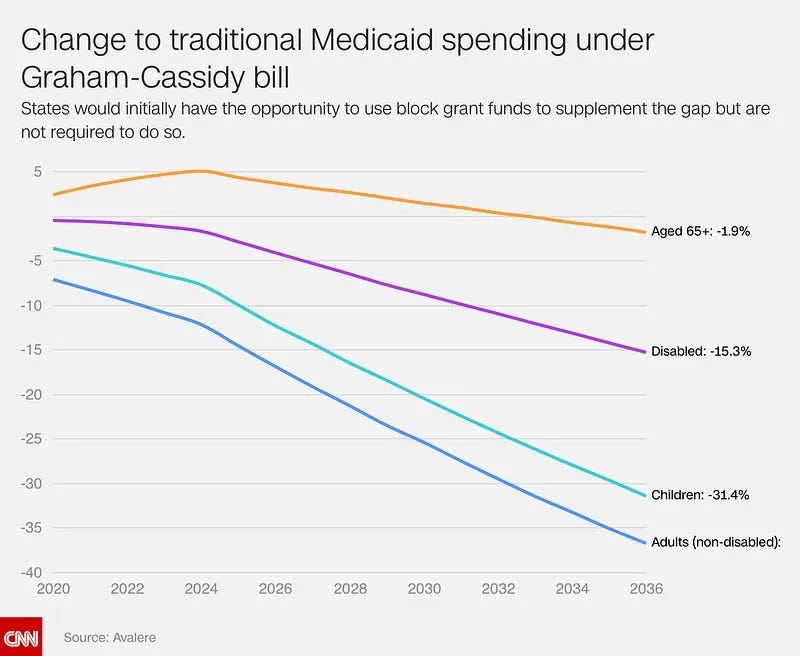
Repeated threats to children’s coverage have demanded vigilance by child advocates over the years. In 2017 alone, proposals to block grant Medicaid would have targeted children with extreme harm, including a Senate proposal by Sens. Lindsey Graham (R-SC) and Bill Cassidy (R-LA), that would have disproportionately slashed children’s coverage by nearly one-third, or 31.4%.
As the legal scholar Michael Freeman has written, in a passage I’ve returned to for years:
It is important that all those that formulate policy should be compelled to consider the impact their policies have on children... All too rarely is consideration given to what policies. . .do to children. This is all the more the case where the immediate focus of the policy is not children. But even in children’s legislation the unintended or indirect effects of changes are not given the critical attention they demand.
That is the single question we’ve tried to hold every piece of federal legislation to for years: “Is it good for children?” Not incidentally, not as an afterthought, but as a direct, deliberate test applied before the vote, not discovered afterward in a CBO score nobody read carefully enough.
MediKids asks and answers that question in the positive for children.
The Goal Is Covering All Kids, but the Ways and Means Do Matter
In a 2020 “Covering All Kids” piece, I explained how the children’s community has been genuinely skeptical of proposals to move children wholesale into other programs, such as the Affordable Care Act (ACA) and Medicare.
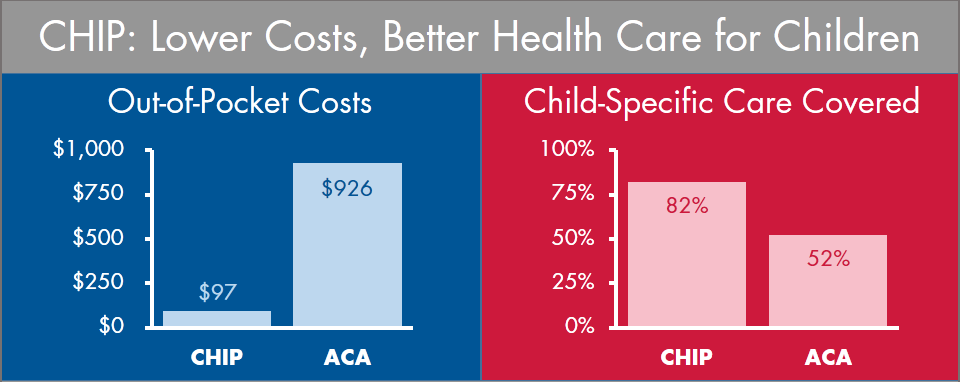
The ACA was built for uninsured adults and, despite the support from some health plans, hospitals, and non-kid advocates, the data demonstrated that children would have been left worse off by moving children from CHIP to the ACA marketplace.
As for Medicare, it was built for seniors and people with disabilities. Although some initial skeptics of Sen. Kim’s MediKids bill have argued instead for a Medicare for All approach, it is important to note that Medicare lacks pediatric benchmarks, pediatric provider networks, and habilitative benefits that Medicaid and CHIP have spent decades building out, and its cost-sharing structure is far less generous to kids than what they have today. Moving millions of children out of Medicaid and CHIP into a program never designed for them risks leaving them worse off in the name of simplicity — the opposite of “do no harm.”
The goal isn’t simply giving every child an insurance card. It is ensuring every child receives the pediatric care they need to grow, learn, and thrive. Insurance is the means. Healthy childhoods are the end.
To achieve that, MediKids builds upon Medicaid and on EPSDT’s comprehensive, pediatric-specific standard of care that already anchors coverage for the tens of millions of children on Medicaid today — rather than replacing it with something built for someone else. In First Focus Campaign for Children’s letter of support for MediKids, we explained why its design meets that “do no harm” standard while embracing the vision of being a guarantee of coverage for every child in the country. Mental and behavioral health, developmental services, dental, vision, and other pediatric benefits are built in from the start.
The automatic enrollment and continuous eligibility provisions go directly at the administrative churn that has been the real driver of coverage loss for children year-after-year. Kids don’t age out of needing health care every twelve months, and their coverage shouldn’t depend on a parent successfully clearing a redetermination hurdle on that same schedule. The legislation’s embrace of covering ALL kids, regardless of immigration status, is important, as it recognizes the need for every child to be able to be immunized or to receive treatment for asthma, cancer, or cystic fibrosis.
There’s a useful, if imperfect, analogy here to the Vaccines for Children (VFC) program. VFC doesn’t require a child to prove they’re uninsured through a complicated application process before they can get immunized. It reaches children who are uninsured, underinsured, or on Medicaid, not every child regardless of coverage status. But the point is that no kids with health care needs should be denied necessary care and treatment.

The Bottom Line
Kids didn’t create the coverage crisis they’re living through, and they can’t wait for Washington to decide it’s ready to fix it. The public has been asking for “covering all kids” in landslide numbers for as long as anyone has bothered to poll it. What’s been missing is legislation that takes that mandate seriously enough to write it into statute rather than treating it as background noise.
MediKids reasserts, in the clearest possible terms, a principle and vision that should never have needed reasserting: no child should go without care because of their parents’ income, their zip code, their immigration status, or the country’s political mood in a given year.
MediKids reminds us that progress is still possible, and that the destination has never really changed. Enough with the backtracking and harm. Now is the time to move forward.
Our kids can’t wait.
What You Can Do
If you would like to support this legislation, you can:
Contact your senators and urge them to cosponsor Sen. Kim’s bill, MediKids (S. 5037).
If you are not already, consider becoming a paid subscriber to this newsletter to support our work on this and other policies of importance to children.
Donate directly to First Focus Campaign for Children to support our advocacy efforts on behalf of children.
Consider joining us as an Ambassador for Children to be a voice for better children’s policies.
ENDNOTES
[1] The initial list of endorsing organizations includes: First Focus Campaign for Children, What To Expect Project, American College of Obstetricians & Gynecologists, (ACOG), ZERO TO THREE, Society for Maternal-Fetal Medicine, American Academy of Pediatrics (AAP), American Academy of Child and Adolescent Psychiatry (AACAP), Association of Women’s Health, Obstetric, and Neonatal Nurses (AWHONN), Association of Maternal and Child Health Programs (AMCHP), National Association of School Nurses, National Education Association (NEA), Families USA, MomsRising, NAACP NJ, Save Our Schools, New Jersey Citizen Action, SPAN Parent Advocacy Network, The Arc of NJ, The New Jersey Chapter - American Academy of Pediatrics, and CASA of New Jersey.
[2] Johnson K. (2021). Medicaid and CHIP Coverage for Women and Children: Politics and Policy. Chapter 20. In Russell Kirby and Sarah Verbiest (editors): Kotch’s Maternal and Child Health: Problems, Programs, and Policy in Public Health. (Textbook 4th Edition). Jones and Bartlett Learning.